Child poverty isn’t a subject I’d usually attempt to write a humorous piece about, but I’m changing the definition of what’s funny – so it’s fine
1June 24, 2015 by Marc Sweeney
In anticipation of statistics detailing what a below average income is in this country, the Institute for Fiscal Studies have forecast that the number of children living in poverty in the UK is set to rise from 2.3 million to 2.5 million.
For many of us the sheer size of that figure is troubling enough. Most of us can’t visualise 2.5 million of anything. Even if I had 2.5 million pennies, that would still amount to £25,000 – about double what I earnt last year (although not anywhere near enough for a Scrooge McDuck-esque coin swimming pool – which I’m sure wouldn’t actually be that comfortable to dive into anyway) and as such, beyond my comprehension.

Probably not the reality.
However the idea of 2.5 million children is all the more terrifying – poverty-stricken or not. It’s bad enough having to supervise 30 of the little horrors – hyped-up on tray bake and jelly in an enclosed soft-play area on a Saturday morning – but 2.5 million? In poverty? Not for all the caramel latte in Seattle, mate.
Spare a thought then, for the Conservative cabinet members called in for a meeting by David Cameron on Tuesday who were presented with the findings and asked for ideas on how best to make them disappear; baring in mind also, that they were tasked with this in the same week that Cameron announced plans to strip away tax credits – the kind of thing that, on the face of it, you might assume runs counter to preventing child poverty.
So with no flexibility in terms of welfare, how do you deal with the sudden appearance of 200,000 poverty-stricken children? In our current society, where it appears as though the gloves are totally off when it comes to making ‘necessary sacrifices’, we can only imagine that the idea of letting 200,000 children actually starve out of existence was floated. Perhaps somebody – misremembering Swift’s Modest Proposal as an old, Conservative policy paper – suggested utilising the weaker members of the 2.5 million as foodstuff for the stronger children. But it’s also entirely plausible, that the same oblivious line of thinking that led to the government insisting upon the destruction of hard drives at the Guardian’s offices – in the age of the bloody internet – led to the suggestion of eating the troublesome statistics the second they’re released. Better yet, why not feed the documents to the impoverished infants? “Exactly how big is this document?”, “Who’s good at fractions?” Etc.

Child poverty statistics? What child poverty statistics?
Whatever was suggested, it appears that the combined wisdom of Oliver Letwin, Nicky Morgan, Iain Duncan Smith and David Cameron have hit upon a solution that involves neither cannibalism nor the appending of nutritional values to official statistics. In lieu of actually helping people in need, the Tories have hit upon the ingenious idea of merely changing the definition of child poverty, or more precisely, how it is measured. At the moment, when a child lives in a household with an income at less than 60% of the national average, then that child is deemed to be in poverty. The tricky thing with this – according to a spokeswoman for Cameron – is that these figures can change relative to the economic prosperity of the nation: in a recession, it might appear that there are fewer children in poverty because the average national income has gone down. The implication being, that now the country is doing so well and we’re all rolling around in money again (although not diving into big pools of it) of course the child poverty statistics have gone up!
I’m not a child and I’m not in poverty, but if I was I can only assume that it would be of little solace to know that my predicament was a mere illusion created by a statistical anomaly – and not just because, as a child, I would lack the requisite vocabulary and arithmetical skills to decode what any of that means – but because I’d probably still be having a pretty shit time of it.
But David Cameron has David Cameron’s record on child poverty to think of, and while he’s comfortable presiding over a decade of rule over a developed, western economy with millions of children in poverty, he’d much rather that number didn’t go up, thank you very much. It makes a man with an estimated net worth of £4 million very uncomfortable at charity dinners. Which is perhaps why his government choose to use the modest data set by the IFS: other organisations with child poverty as their focus put the figure at 3.5 million (Child Poverty Action Group, Barnardos) So by simply shopping around for your ‘official’ figures you can magically lift one million children out of poverty – who knew?
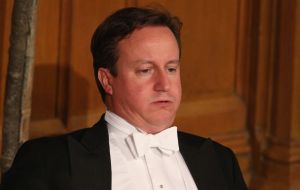
Cameron looking uncomfortable at a dinner. Source: Independent
Only time can tell what measures Cameron’s new, improved definition of child poverty will draw upon, but a nation waits with baited breath: If he or she has both parents present in the home, are they in poverty? What if they have more than one TV in the house? Shoes? Have they got more than one pair of shoes? Not even one size up so they’ll last two school years? Get them out of those statistics! Witness, children from far-flung, forgotten parts of the UK, being almost literally flung up the social ladder into better living – all thanks to a few amendments to an annoyingly vague term!
Will he stop there? Perhaps Cameron will go further and change how they measure proper child care, so it can include the odd abandonment of one in a public house; or better yet, maybe his cabinet will together agree that our concept of a child needs complete reworking, and that once you’re five, you can bally well get down to the textiles factory that isn’t there any more and earn a living like the rest of us can’t – who knows? But these are exciting times, both for the poor and those who delight in the development of the English language: what does poverty in the UK mean in this day and age? Our Eton and Oxbridge overlords will let us know soon enough.
 Marc Sweeney
[…] On the basis of Tory rhetoric, it would seem as though that if you’re not quite fitting into the definition of ‘hard-working person’ then it’s because you’re not putting enough effort in – certainly if you’re unemployed or not finding enough hours of work. That there are around 2 million people unemployed – with many more above that figure under-employed actively looking for better-paid work or more hours than they are currently offered – fighting it out for less than 500,000 full-time or part-time roles, does not dissuade the government from placing the blame on members of the public for having the audacity of being poor and finding themselves in a position where they need to ask for help. Presumably, they expect the remainder of plebs that don’t find employment to all become self-starting, small-to-medium business entrepreneurs in a country where massive, international corporations are handed large government subsidies to assure their stranglehold on the market. Good luck with your ventures guys and gals! Also, if you’re a child you’re not a ‘hard-working person’ either are you? So don’t expect anything from this budget to alleviate that poverty that you’re in – that poverty that won’t even be acknowledged soon. […]